For most individuals, selecting an engagement ring is one of the most high-stakes decisions they will ever make. I understand this pressure because I see it every single day in my office as clients navigate the delicate balance between budget and significant visual impact.
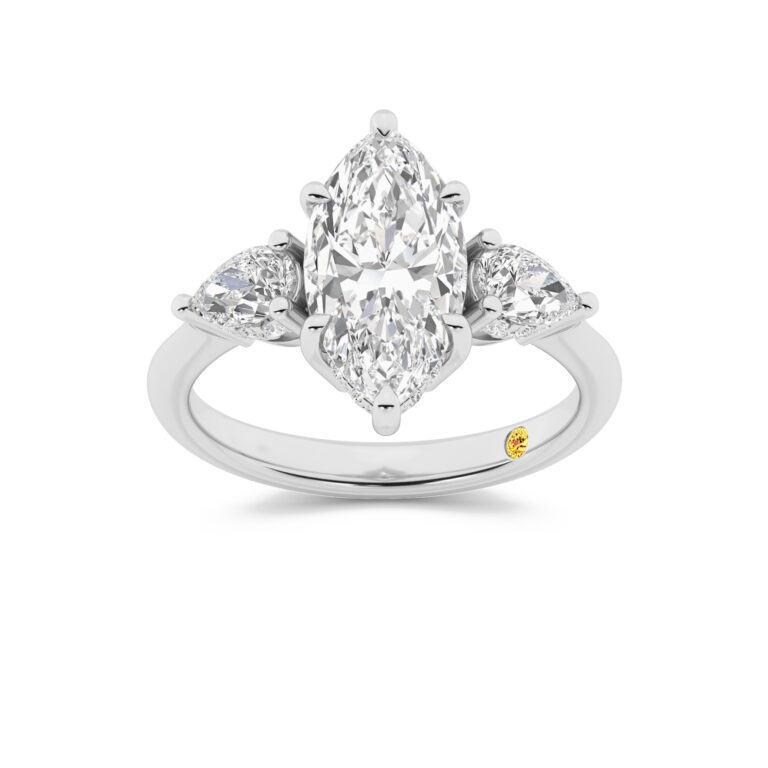
My goal today is to simplify this process using the expertise gained from over thirty years of manufacturing jewelry and continuing my family’s third-generation diamond tradition. Through this 3 stone marquise engagement ring guide, I want to show you exactly how to achieve the most breathtaking look without compromising on quality.

Why Does a Marquise Cut Diamond Offer the Best Visual Spread?
A marquise cut diamond looks physically larger than a round or square diamond of the identical carat weight because it possesses a greater surface area on the top.
Over decades spent sorting thousands of diamonds in my office, I have consistently found this elongated shape to be the undisputed champion for maximizing what we jewelers call “finger coverage.” The long, slender outline physically stretches the visual weight of the stone.
To put this in perspective, if I were to place a 1.5-carat round diamond next to a 1.5-carat lab grown diamond engagement ring featuring a marquise cut on a client’s hand, the marquise immediately appears significantly bigger. Ultimately, it is the intelligent path to maximizing impact and choosing the biggest look for your budget.
What is the Diamond Bow-Tie Effect and How Do Jewelers Avoid It?
A diamond bow-tie effect is a dark shadow across the center of a marquise diamond that appears when a stone is poorly cut, preventing light from properly reflecting back to the eye. Eliminating this shadow is the absolute non-negotiable mark of a high-quality cut.
This frustrating shadow occurs because the angles on the shallow facets are not aligned correctly. As beautifully explained by the Gemological Institute of America (GIA), the bow-tie is a common optical phenomenon in elongated shapes that must be carefully managed by a master cutter.
In our manufacturing process, we simply reject stones with this severe effect. You deserve a three stone marquise engagement ring that flashes brilliantly across its entire surface, which only happens when we insist on precise optical engineering.
Are Side Stones Essential for a Marquise Cut Ring?
Yes, because adding complementary side stones to a center marquise diamond is critical for softening the sharp points and maximizing the continuous “span” across the hand.
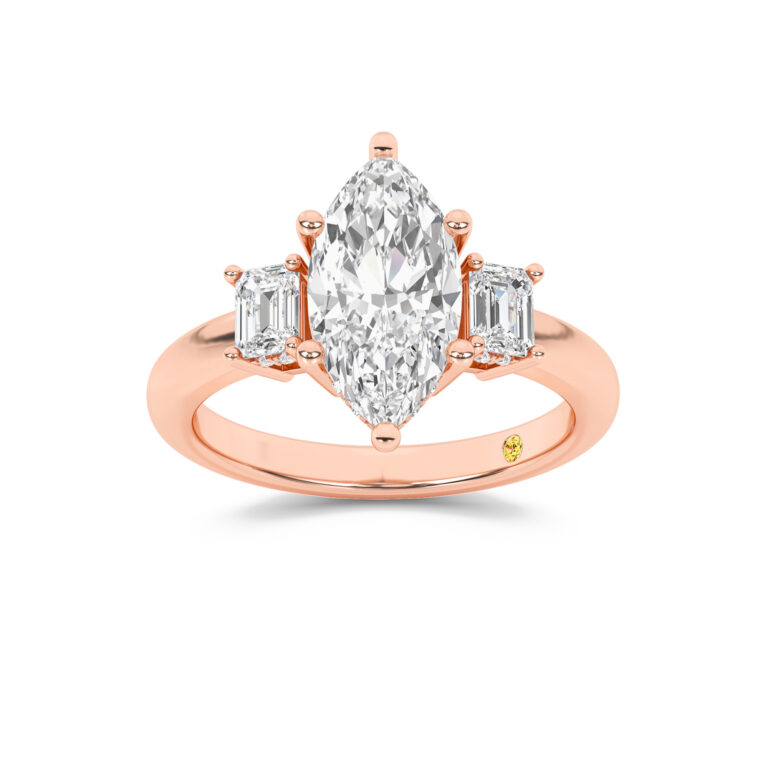
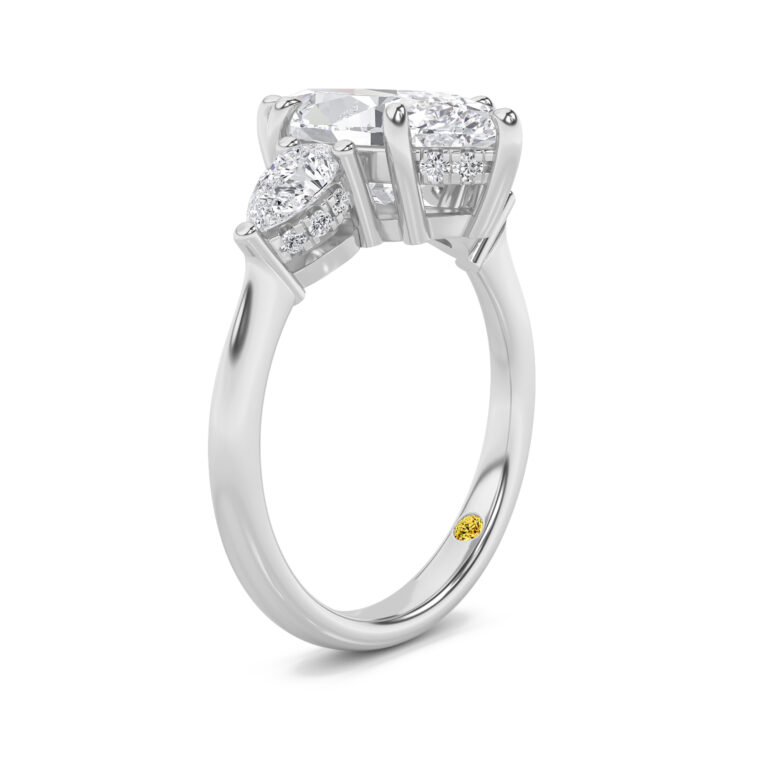
While a traditional solitaire is certainly elegant, the specific structural design of a 3 stone diamond engagement ring creates a massive, brilliant band of light that sweeps across the entire finger. For this reason, I always advise my clients to focus on pairing the center stone with shapes that flow seamlessly into the main diamond—a core principle of this 3 stone marquise engagement ring guide.
If you’re feeling a bit unsure about which arrangement suits your personal style best, our comprehensive guide on how to choose the perfect setting for your three stone diamond engagement ring is a fantastic place to start exploring your options.

The Role of Trillion Cut Side Stones in a Marquise Ring
Trillion cut diamonds are essential because they provide a broad, geometric base that perfectly sits against the side points of the marquise, creating a smooth and widening visual transition.
The straight edge of the trillion sits beautifully flush against the center stone, while the gently angled outer edges gracefully soften the transition down the shank of the ring.
Whenever we custom design an engagement ring to cast a brand-new setting, we ensure this fit is mathematically exact. This precise relationship guarantees there is no “dead space” between the diamonds, resulting in a continuous wall of sparkle.

The Visual Benefit of Pear Shape Side Stones
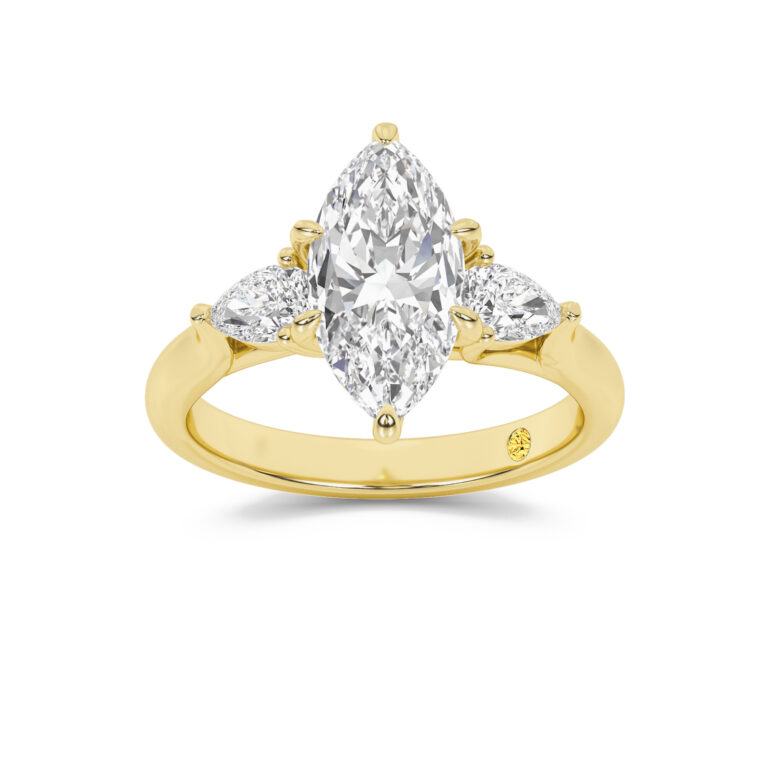
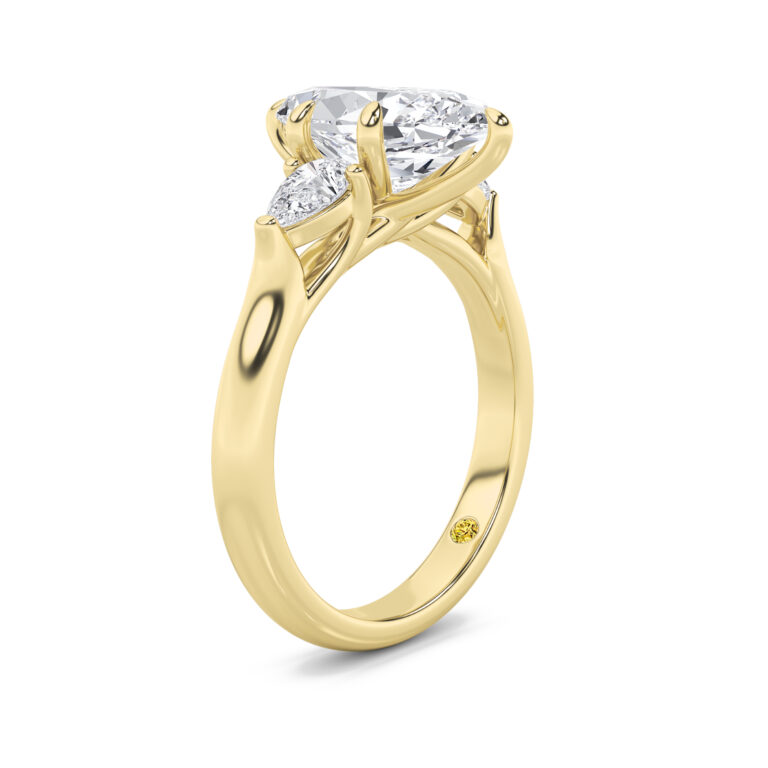
Pear shape side stones are important because they offer a softer, more organic curve that provides a similar broadening effect but with a more rounded overall aesthetic. Using pears gives us the creative flexibility to point the sharp end toward the center marquise or flip it to face away from it.
To see beautiful examples of this dynamic layout in action, you can explore various three stone pear engagement ring styles. Regardless of the direction you choose, both configurations drastically increase the visual real estate the ring occupies on the hand, offering a breathtaking alternative to the standard trilogy engagement ring.
How Does Choosing Lab-Grown Diamonds Impact a 3 Stone Setting?
Choosing lab-grown diamonds allows you to maximize the stone size and quality for a fixed budget because lab-grown diamonds are a more modern and intelligent choice that often provides better value.
Today, this is the premium and logical selection for the sophisticated modern buyer who wants the most impact. When clients are looking at marquise settings in my office, deciding to customise engagement rings with lab-created stones allows them to obtain a much higher color and clarity grade in significantly larger carat sizes.
This wise choice directly results in superior brilliance and a visually larger ring for the exact same investment.

Diamond Spread and Coverage Comparison
To help you visualize this impact, here is a quick breakdown of how different shapes compare:
| Shape | Visual Length (mm) for 1ct | Perceived Size | Best Features for Budget |
| Marquise | ~10.0mm | Largest | Undisputed King of “Spread” |
| Pear | ~8.5mm | Large | Broad and soft asymmetry |
| Oval | ~7.7mm | Medium | Wide visual footprint |
| Round | ~6.5mm | Smallest | Maximum fire and brilliance |
The Durability of 14k and 18k Gold in a 3 Stone Ring
14k or 18k gold provides the ideal structural integrity for a 3 stone ring, securing multiple stones for daily wear while providing a classic, warm aesthetic. We strictly work with premium gold in white, yellow, or rose to create settings that are as structurally sound as they are beautiful.
For those drawn to warmer, vintage-inspired metal tones, reading our jeweler’s guide to yellow gold three stone engagement rings can be highly beneficial when making your choice. Practically speaking, 14k gold—which we often recommend for daily wear—contains less pure gold and more hardening alloys, making it incredibly durable and highly resistant to scratches.
This is a crucial consideration for protecting a 3 stone ring that naturally has a wider profile and more surface area exposed to potential daily contact.
Structural Integrity and Setting Maintenance
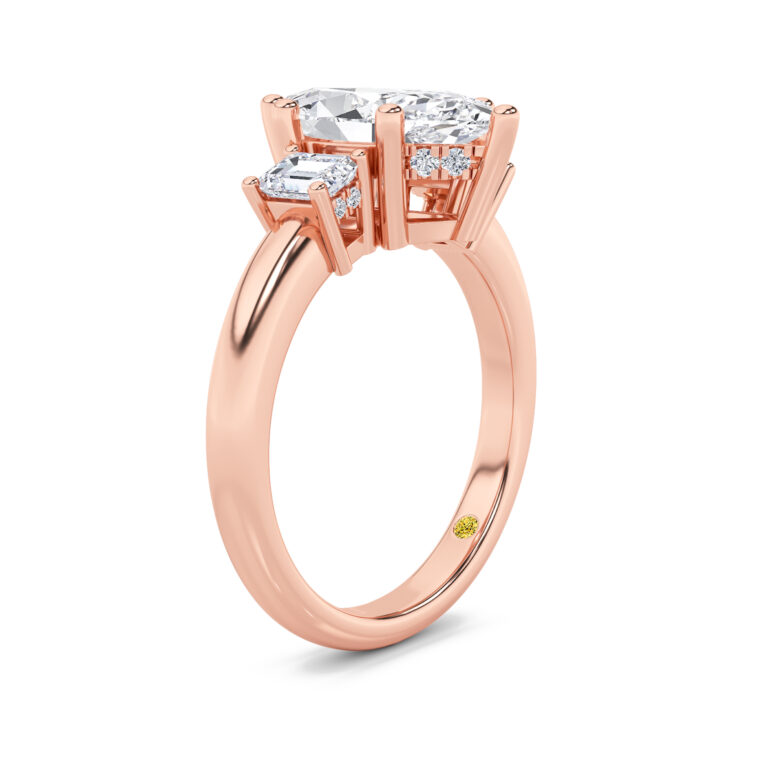
When we cast our brand-new gold settings, we engineering-design them to hold multiple stones securely, using precisely planned prongs. This meticulous structural integrity is something I prioritize above all else, simply because a 3 stone ring inherently has more points of potential weakness than a solitaire.
Every single prong is handcrafted to be both visually beautiful and intensely functional. Furthermore, when we accept trade-in jewelry in my office, we never reuse the old setting; instead, we melt it down and cast a new, clean ring from the resulting gold, which guarantees its long-term integrity for decades to come.
Conclusion
Choosing a 3 stone marquise engagement ring is a masterstroke in achieving maximum finger coverage and an authoritative presence. As you have learned throughout this 3 stone marquise engagement ring guide, by prioritizing an elongated marquise cut, you instantly maximize the visual spread for your budget, getting the most luxurious look possible.
The critical next steps are selecting side stones that seamlessly flow into the main diamond and ensuring the cut quality is precise enough to eliminate the dreaded bow-tie effect.
At La Joya Jewelry, we are deeply dedicated to crafting these technically challenging settings using only the finest 14k and 18k gold to provide a lasting, structurally sound piece that reflects our three generations of expertise. When you are ready to begin your journey, we invite you to explore our collection to find your perfect match.