Everyone wants an engagement ring that stops people in their tracks with brilliant sparkle, but achieving that “wow” factor often seems to cost a fortune. As a jewelry manufacturer for over 30 years, I have created this round halo engagement ring guide to show you how one specific design delivers more size and sparkle for your budget than any other.
In this guide, I’ll explain everything about the round halo style—from how the optical illusion works to why a lab-grown diamond is the absolute best choice for this magnificent setting.

What Defines a Round Halo Engagement Ring?
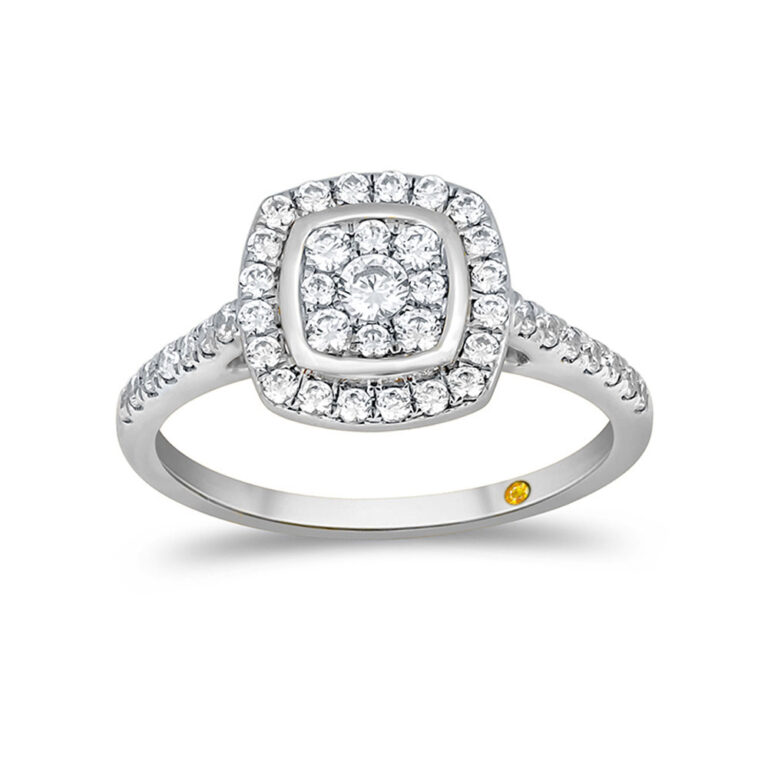
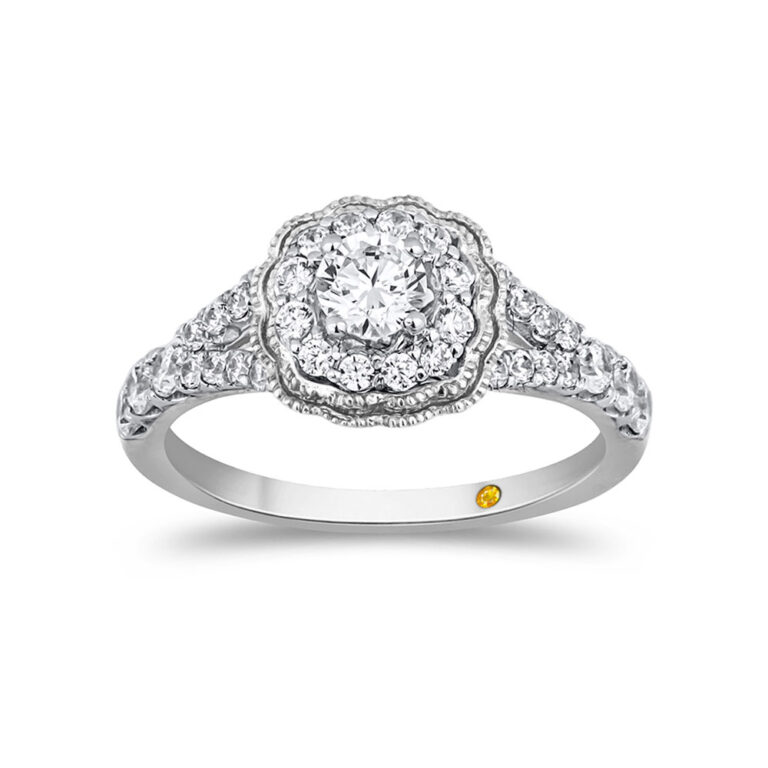
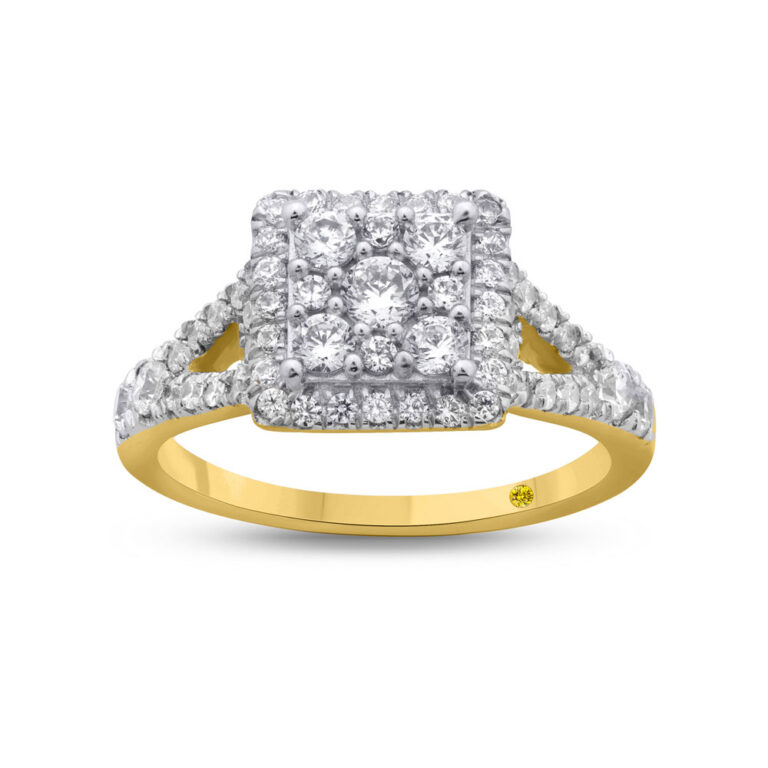
A round halo engagement ring is defined by a central round-cut diamond that is completely encircled by a border, or “halo,” of smaller accent diamonds.
A round halo engagement ring has two main parts. First, it has a beautiful, round -cut diamond in the center. Second, that center diamond is perfectly encircled by a ring, or “halo,” of smaller accent diamonds.
Think of it this way – The center diamond is the star of the show. The halo is a brilliant spotlight shining on that star. The spotlight itself sparkles, but it also makes the star appear brighter and bigger.
In my experience, this style has remained one of the most popular for decades. The reason is simple – It just works. It delivers maximum visual impact for the investment. Consequently, it has become a timeless, classic choice, joining the ranks of other beloved styles like oval halo engagement rings and pear shaped halo engagement rings.
How Does a Halo Setting Make a Diamond Look Bigger and More Brilliant?
A halo setting makes a diamond look bigger by tricking the eye into seeing the outer edge of the accent stones as the boundary of a single massive gem.
The primary appeal of halo style engagement rings is their ability to enhance the center stone. They do this in two very powerful ways.
How a Halo Makes Your Diamond Look Bigger
A halo is a brilliant optical illusion. Your eye does not see the edge of the center diamond. Instead, your eye sees the outer edge of the halo. Because of this, the halo visually extends the diamond’s surface, making the entire centerpiece look like one large, sparkling diamond.
Here is a practical example from my manufacturing experience – A 1.0 -carat round diamond is about 6.5mm across. By adding a simple halo, the total width can jump to 8.5mm or 9mm. This gives the ring the same “finger coverage” as a 2.0 -carat or even 2.5 -carat solitaire diamond. You get the look of a much larger stone without paying for that carat weight in the center.
How Do Halo Rings Maximize Fire and Brilliance?
Halo rings maximize fire and brilliance by adding dozens of small faceted mirrors that catch light escaping the center stone and bounce it back to the viewer’s eye.
Let’s quickly define two terms I use every day, which are essential to understanding diamond beauty. According to the Gemological Institute of America (GIA), “brilliance” is the white light that reflects from a diamond—it’s the brightness. “Fire” is the colorful sparkle, those flashes of rainbow color you see when the diamond moves.
A halo maximizes both. A single round diamond has 57 or 58 facets (or tiny mirrors). A halo ring adds dozens of more facets with all the small stones. This creates a “hall of mirrors” effect. Light enters the center stone, bounces out, but instead of escaping, it might hit a halo diamond. That diamond then flashes and bounces the light back, perhaps to another halo diamond.
The result is a controlled explosion of light. You get more white -light brilliance and more colorful fire from every possible angle.
To learn more read my complete halo engagement ring guide
Why Choose a Lab -Grown Diamond for Your Halo Ring?
You should choose a lab-grown diamond for your halo ring because it provides physically and optically identical brilliance to mined stones at a fraction of the cost, allowing for perfectly matched color and clarity.
For a halo ring, a lab-grown diamond is the only smart option because it allows you to buy a center stone that is worthy of the setting. Lab-grown diamonds are 100% real diamonds—chemically, physically, and optically identical to mined stones—but cost 60-80% less.
This is the most important advice I can give you. In my 30+ years in this business, the single biggest and best innovation has been the lab -grown diamond. For a halo ring, a lab -grown diamond is not just an option. In my professional opinion, the lab grown diamond engagement ring is the only smart option.
Why Are Lab-Grown Diamonds the Best Value for Halo Rings?
Lab-grown diamonds are the best value for halo rings because their efficient creation process drastically reduces costs, allowing you to afford a significantly larger and higher-quality center stone.
Think about the optical power of your chosen setting. It naturally makes your stone look bigger. Imagine combining that visual trick with a center gem that is actually massive. For the same budget, you can mount a 1.5-carat lab diamond instead of a tiny 1.0-carat mined option. The final ring will look absolutely spectacular. Purchasing lab-grown gems simply represents a more intelligent investment.
What Makes Lab-Grown Diamonds an Ethical Choice?
Lab-grown diamonds represent an ethical choice because they require no industrial mining and guarantee a fully conflict-free origin.
Today’s couples are smart. They care about where their products come from. This is a major shift I’ve seen in the industry.
A lab -grown diamond is the modern, 21st -century choice. You have a 100% guarantee that your diamond is conflict -free. In addition, the environmental footprint is a tiny fraction of what industrial mining requires. This gives you peace of mind. Your beautiful ring, a symbol of your love, is a clean and ethical choice you can be proud of.

What Are the Different Halo Fitting Styles?
The two primary halo fitting styles are the floating airline, which leaves a visible gap around the center stone, and the seamless fit, which places the halo tightly against the center diamond.
In this round halo engagement ring guide, I want to share two manufacturing details that drastically change the ring’s personality.
-
The “Airline” (Floating Halo): Some designers intentionally leave a visible gap between the center stone and the halo. This is called an “airline.” It makes the center stone stand out as a distinct individual diamond.
-
The Seamless Look: Most buyers prefer no gap. This requires the halo to be custom-fitted to the exact millimeter of the center stone, creating the illusion of one giant, continuous diamond.
-
The “Flower” Effect: Be careful with the size of the halo stones. If they are too large, the ring looks like a floral cluster. If they are small (micro-pavé), it looks like a sleek, modern rim of light.
Quick Guide: Choosing Your Halo Style
| Halo Design | The Look | Best For |
|---|---|---|
| Micro-Pavé Halo | Seamless “wall of light” with tightly set diamonds | Maximizing the size illusion of the center stone |
| Shared-Prong Halo | Clearly visible individual diamonds with added depth | Extra sparkle and textured brilliance |
| Floating Halo (Airline) | Center diamond appears elevated and well-defined | Modern and architectural engagement ring styles |
| Floral Halo Design | Larger accent stones arranged in a petal-like pattern | Vintage-inspired and romantic jewelry lovers |
How Should You Prioritize the 4Cs for a Halo Engagement Ring?
You should prioritize Cut and Color over Clarity and Carat weight when selecting diamonds for a halo engagement ring. Applying the standard grading rules changes slightly for this specific design. Here is exactly what I tell clients visiting my office.
When buying for a halo, the 4 C’s (Cut, Color, Clarity, Carat) are applied slightly differently.
Why is Diamond Cut the Most Important Factor for a Halo?
Diamond cut is the most important factor for a halo because exact proportions are required to reflect light outward into the surrounding accent stones rather than letting it leak through the bottom.
It is the engine of your ring’s sparkle. If the center stone is dull, the halo will look like a “donut” of light around a dark hole.
This is the most important “C” for any diamond, and it is especially true for a halo. Cut refers to the diamond’s angles and proportions—it does not mean the shape. A perfect “Excellent” or “Ideal” cut is what unlocks fire and brilliance.
You can have a high -color, high -clarity diamond, but if the cut is “Good” or “Fair,” it will look dull. No halo setting can fix a dead, poorly cut stone.
When a diamond is cut too deep or too shallow, it suffers from ‘light leakage.’ Instead of bouncing back up to your eye, the light falls out of the bottom of the stone, creating lifeless dark spots. A precision cut is the only way to push maximum fire outward into your surrounding halo
Why Is Color Matching Critical for a Halo Ring?
Color matching is absolutely critical for a halo ring because any difference between the center stone and the accent diamonds makes the main gem appear yellow or dull by contrast.
Color is graded from D (colorless) to Z (light yellow). For a halo, the most important rule is that your center stone must match the small halo diamonds (called ‘melee’). Most high -quality halos use G -color or H -color melee. Therefore, your center diamond should be in that same range (G or H) or slightly better (D, E, or F). If you put a J -color or K -color center stone in a G -color halo, the contrast will be obvious. The center stone will look yellow against the bright white halo.
What Clarity Grade is Best (and a Waste of Money) for a Halo Ring?
A VS1 or VS2 clarity grade is best for a halo ring, while Flawless or VVS grades are a waste of money because the intense surrounding sparkle naturally hides minor inclusions.
Clarity measures a diamond’s inclusions or flaws. Here is an industry secret – the halo is fantastic at hiding inclusions. The intense sparkle from the surrounding stones makes it very difficult to see small flaws in the center stone. You do not need to pay for a “Flawless” or “VVS” diamond. In my opinion, a “VS1” or “VS2” diamond is a perfect choice. Even a well -chosen “SI1” diamond can look completely “eye -clean,” meaning you can’t see any flaws just by looking at it.
This saves you a significant amount of money. You can then use those savings to get a larger carat weight or a better cut.
How Does Carat Weight Affect a Halo Setting?
Carat weight affects a halo setting by dictating the overall physical spread of the ring, though the halo itself already adds the visual equivalent of up to a full carat in size.
Thanks to your halo setting and your choice of a lab -grown stone, you are already winning here. You will have a ring that looks huge and a center stone that is significantly larger for your budget. Choose the size that you love and that looks balanced on your hand.

What Are the Different Types of Halo Settings?
The different types of diamond halo engagement ring settings include the classic flush halo, the hidden under-halo, and the glamorous double halo. Not all diamond rings follow the exact same blueprint. While round cuts remain timeless, jewelers also apply these borders to princess and emerald shapes.
What Is a Classic Halo Setting?
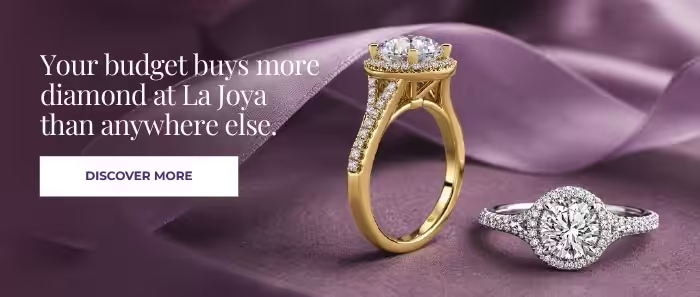
A classic halo engagement ring setting places the surrounding diamonds on the exact same level as the center stone to create a flush, continuous surface of brilliance. This seamless design generates the most powerful size illusion possible.
What Is a Hidden Halo Setting?
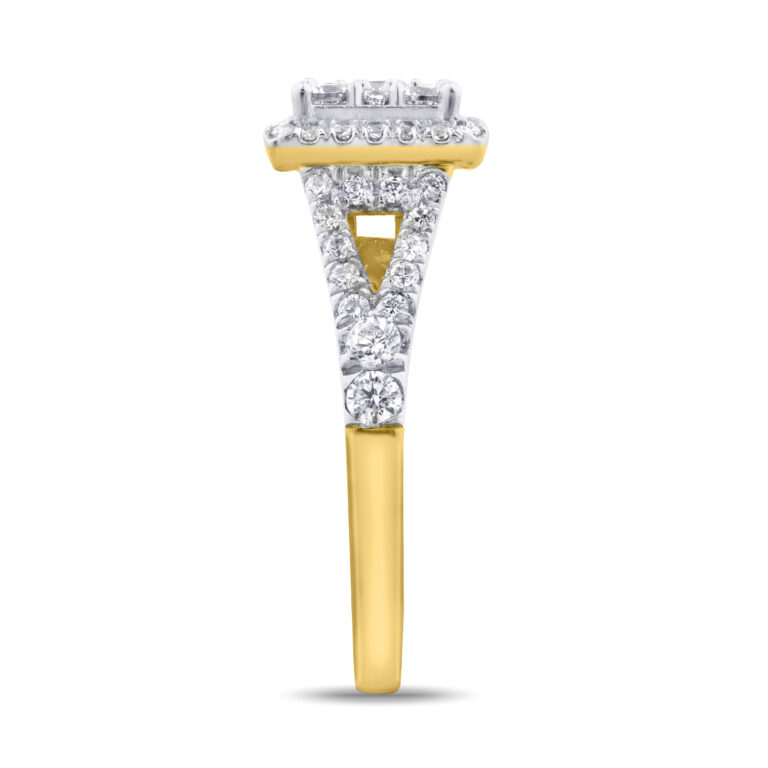
A hidden halo engagement ring setting features a secret ring of diamonds placed beneath the center stone, visible only from the side profile of the ring. From the top down, it looks exactly like a traditional solitaire. Viewing the piece from an angle reveals an elegant pop of unexpected sparkle.
What Is a Double Halo Setting?
A double halo setting features two concentric rings of accent diamonds surrounding the center stone to maximize the visual footprint of the ring. If you want staggering visual impact, this delivers perfectly. This bold look easily makes a 1.0-carat gem look absolutely massive. However, delicate hands might find two diamond borders slightly overwhelming.
For a deep dive read my double halo engagement ring guide
Which Gold Alloy Is Best for a Halo Ring?
Strong 14k or 18k gold in white, yellow, or rose hues is the best metal for a halo ring because it holds tiny accent stones securely without the scratching issues associated with platinum. I strongly advise against platinum for delicate micro-pavé work. Platinum acts dense but scratches incredibly easily, dulling over time. Reliable 14k or 18k gold keeps every tiny gem locked perfectly in place.
Why Is White Gold Popular for Halo Rings?
White Gold is popular for halo rings because its bright, rhodium-plated finish blends seamlessly with the diamonds to make the entire ring appear larger. It remains the top choice by a wide margin. The white metal prevents any color clash with clear stones. Routine replating every year or two keeps it looking brand new.
How Does Yellow Gold Affect a Halo Ring?
Yellow gold affects a halo ring by providing a warm, vintage-inspired contrast that makes the bright white diamonds stand out prominently. Many clients request this classic look. Jewelers often cast the top diamond-holding prongs in white gold anyway. This clever trick keeps the gems icy white while delivering a rich golden band.
What Look Does Rose Gold Create for a Halo Ring?
Rose gold creates a modern, romantic look for a halo ring by using a pinkish alloy to warmly frame the brilliant white center and accent stones. It has become incredibly fashionable recently. The soft tone highlights the geometric structure of the diamond border beautifully
What Are the Most Common Mistakes When Buying a Halo Engagement Ring?
The most common mistakes when buying a halo engagement ring include mismatching diamond colors, allowing visible gaps, and reusing fatigued metal instead of melting it down for a fresh casting. After decades at the bench, I see these errors repeatedly.
Mismatching Color and Clarity
This is the biggest one. Please do not put a J-color center stone in a G-color halo. The difference will be obvious. Furthermore, ensure the clarity of the tiny halo stones (melee) matches your lab-grown center; cheap, cloudy melee will look gray next to a pristine center stone. Keep your grades tightly matched.
A Noticeable Gap
Look closely at the ring. A high -quality halo should be “custom -fit” to the center stone. There should be no visible gap between the center diamond and the halo diamonds. A large gap is a sign of poor, mass -produced craftsmanship. This is why exploring custom engagement rings can ensure a perfect, seamless fit.
Prioritizing Clarity Over Cut
Do not spend all your money on a “Flawless” diamond if it means you have to get a “Good” cut. A Flawless but poorly cut diamond will be dull. A slightly included (VS2/SI1) diamond with an Excellent cut will be a fireball of sparkle.
Overpaying for a Mined Diamond
The most tragic mistake is seeing a couple spend their entire budget on a tiny, 0.70 -carat mined diamond. They could have had a stunning, eye -clean, 1.5 -carat lab diamond for the same price. Don’t buy the old -fashioned marketing. Buy the better, more beautiful, and more intelligent stone.
Forgetting About the Wedding Band
A small mistake, but a common one. Some intricate halo settings don’t sit flush against a straight wedding band. If you want your bands to “stack” perfectly, make sure to check this or choose a “cathedral” style halo.
Reusing Tired Metal
If you are upgrading an older ring, do not let a jeweler simply bend or polish the old prongs to fit new stones. Fatigued metal has hidden weak points. To prevent your tiny halo diamonds from falling out, the gold must be completely melted down and freshly cast to ensure the prongs are perfectly strong.
The Lasting Value of a Properly Engineered Halo Ring
A properly engineered halo ring maximizes your center stone’s fire while delivering an incredibly impressive size profile. Combining this brilliant design with a high-quality lab-grown diamond gives you unmatched value and ethical peace of mind.
We invite you to experience this precision craftsmanship firsthand. Let our decades of expertise help you find the perfect symbol of your love at La Joya Jewelry.